A Practical Evidence Log for Small OSINT Investigations
BY OSINT BLOG
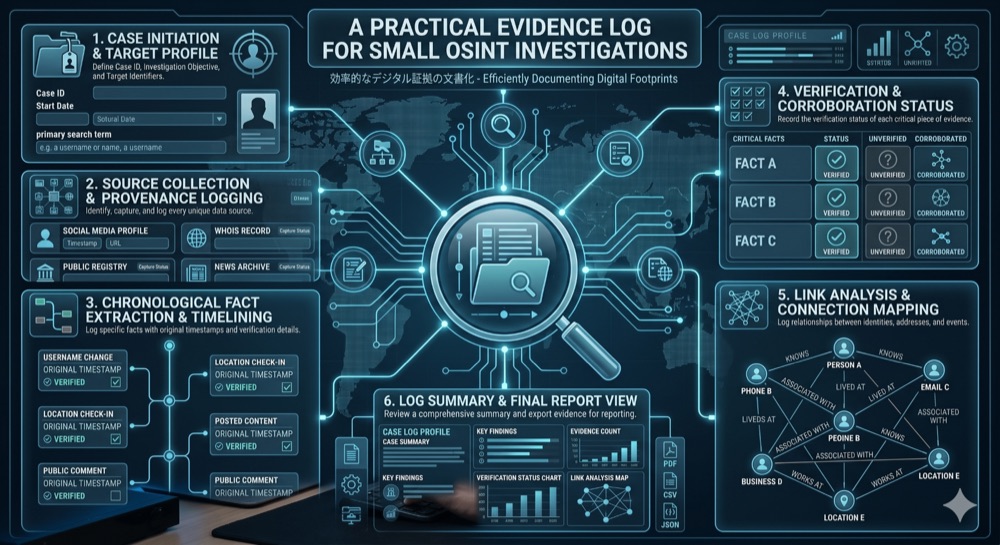
Introduction: Why Evidence Logging is Critical
In OSINT investigations, the quality of your conclusions depends on the quality of your evidence and your ability to demonstrate how you arrived at those conclusions. An evidence log—a systematic record of all information collected, its sources, and how it was obtained—is essential for:
- Maintaining chain of custody
- Enabling verification and reproducibility
- Building defensible intelligence products
- Identifying gaps in analysis
- Supporting legal or formal proceedings
- Collaborating effectively with team members
What is an Evidence Log and Why It Matters
An evidence log is a chronological record of all evidence collected during an investigation. It documents:
- What information was collected
- Where it came from (source)
- When it was collected
- How it was collected (methodology)
- Who collected it
- How it was stored and preserved
- How it relates to investigation objectives
A proper evidence log creates an audit trail that allows anyone to understand your investigation process and verify your conclusions.
Key Components of an Effective Evidence Log
**1. Unique Identifier** Assign each piece of evidence a unique ID (e.g., EV-001, EV-002) for easy reference.
**2. Date and Time** Record when the evidence was collected. Include timezone if relevant.
**3. Source Information** Document the source in detail: - Source name/URL - Source type (website, social media, document, etc.) - Source credibility assessment - Source URL or location
**4. Collection Method** Describe how the evidence was obtained: - Direct observation - Screenshot (with metadata) - Download - API query - Interview - Other
**5. Evidence Description** Provide a clear, objective description of the evidence: - What is it? - What does it show? - Key details or quotes
**6. Relevance to Investigation** Explain how this evidence relates to investigation objectives: - Which hypothesis does it support or contradict? - What question does it help answer?
**7. Collector Information** Record who collected the evidence and any relevant context.
**8. Storage and Preservation** Document how the evidence is stored: - File location - Backup location - Preservation method - Access restrictions
Documenting Sources and Collection Methods
Be specific about how you obtained information:
**Screenshots**: Include metadata (date, time, URL). Consider using tools that preserve metadata.
**Downloads**: Record the original URL, download date, and file hash (MD5 or SHA-256) to verify the file hasn't been modified.
**Archived content**: Use archive.org or similar services and record the archive date.
**Social media**: Record the post URL, username, date posted, and any relevant context.
**APIs**: Document the API endpoint, query parameters, and response date.
**Interviews**: Record date, time, participant names, and key information discussed.
Maintaining Chain of Custody
Chain of custody documents the handling of evidence from collection to analysis:
1. **Initial collection**: Who collected it? When? How? 2. **Storage**: Where is it stored? Who has access? 3. **Transfer**: If evidence is transferred between people, document the transfer 4. **Analysis**: Who analyzed it? When? What was the analysis? 5. **Preservation**: How is it preserved? Are backups maintained?
For digital evidence, maintain: - Original files (unmodified) - Working copies for analysis - Backup copies - File hashes to verify integrity
Organizing Evidence for Analysis
Organize your evidence log for easy reference:
**By investigation phase**: Group evidence by investigation stage (initial research, hypothesis testing, verification, etc.)
**By hypothesis**: Organize evidence by which hypothesis it supports or contradicts
**By source type**: Group evidence by source (social media, documents, interviews, etc.)
**By timeline**: Organize evidence chronologically
Use tags or categories to enable multiple organizational schemes.
Tools and Templates for Evidence Logging
**Spreadsheet-based logs**: Simple CSV or Excel spreadsheets work well for small investigations
**Dedicated tools**: - Case management software (Palantir, i2 Analyst's Notebook) - Evidence management systems - Custom databases
**Template structure**: ``` Evidence ID | Date | Source | Type | Description | Relevance | Collector | Storage | Status ```
Common Mistakes and How to Avoid Them
1. **Incomplete documentation**: Record all details at collection time—don't rely on memory later 2. **Vague descriptions**: Be specific about what evidence shows, not interpretations 3. **Missing source information**: Always record where information came from 4. **Poor organization**: Use consistent naming and organization schemes 5. **Inadequate preservation**: Maintain backups and verify file integrity 6. **Mixing evidence and analysis**: Keep raw evidence separate from your interpretations 7. **Incomplete chain of custody**: Document every step of evidence handling
Practical Example of an Evidence Log
``` EV-001 | 2026-06-15 10:30 UTC | @suspicious_account (Twitter) | Social Media Post | Tweet claiming to be journalist, includes photo | Supports H2 (impersonation) | Analyst A | /evidence/twitter/ev-001.png | Verified
EV-002 | 2026-06-15 11:15 UTC | archive.org | Archived Website | Archived version of account from 2025-01-01 | Contradicts H1 (legitimate account) | Analyst A | /evidence/archive/ev-002.html | Verified
EV-003 | 2026-06-15 14:00 UTC | LinkedIn | Professional Profile | Real journalist's LinkedIn profile | Corroborates H2 (impersonation) | Analyst B | /evidence/linkedin/ev-003.pdf | Verified ```
Conclusion
A comprehensive evidence log transforms OSINT investigations from informal research into systematic, defensible intelligence work. By documenting sources, collection methods, and chain of custody, you create an audit trail that enables verification, supports collaboration, and builds confidence in your conclusions. Whether you're conducting a small investigation or a large-scale analysis, implementing evidence logging practices from the start will improve the quality and credibility of your work.