How to Separate Observation from Assumption in an OSINT Investigation
BY OSINT BLOG
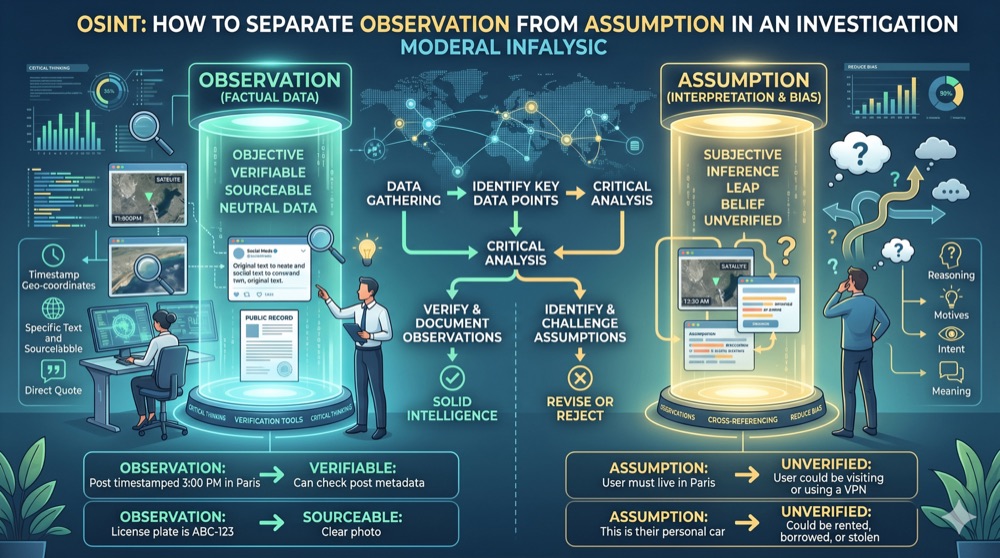
Introduction: Why Observation vs Assumption Matters in OSINT
Open Source Intelligence (OSINT) is built on the foundation of gathering, analyzing, and interpreting publicly available information. However, one of the most critical challenges that OSINT practitioners face is the tendency to blur the line between what they actually observe and what they assume or infer from those observations. This distinction is not merely academic—it can be the difference between a credible intelligence assessment and a flawed conclusion that leads to poor decision-making.
In the world of intelligence analysis, assumptions can be dangerous. They can lead to confirmation bias, where analysts unconsciously seek information that confirms their preexisting beliefs while dismissing contradictory evidence. They can result in analytical failures that have real-world consequences. Understanding how to separate observations from assumptions is therefore a fundamental skill for any OSINT professional.
This article explores the critical distinction between observations and assumptions, examines the cognitive biases that lead us astray, and provides practical techniques for building stronger, more reliable intelligence assessments.
Defining Observations: Direct, Verifiable Facts
An observation in OSINT is a direct, verifiable fact that can be independently confirmed through multiple sources or methods. Observations are the raw data of intelligence work—they are what you can see, read, hear, or measure without interpretation.
Examples of observations include: - A photograph showing a person at a specific location on a specific date - A public social media post with a timestamp and visible content - A news article published by a reputable outlet with byline and date - A government document with official seals and signatures - Geolocation data from a verified source showing coordinates - A video recording with metadata indicating when and where it was captured
Observations have several key characteristics:
**Verifiability**: Other analysts should be able to independently verify the same observation using the same sources or methods.
**Specificity**: Observations are concrete and detailed. Rather than "the person looked suspicious," an observation would be "the person wore a red jacket and carried a black backpack."
**Source Documentation**: Good OSINT practice requires documenting where the observation came from, when it was accessed, and how it can be verified.
**Reproducibility**: The observation should be reproducible—if you return to the source, you should be able to find the same information again (accounting for content removal or updates).
Defining Assumptions: Inferences and Analytical Judgments
Assumptions, by contrast, are inferences or analytical judgments made based on observations. They represent the analyst's interpretation of what the observations mean. While observations are facts, assumptions are conclusions drawn from those facts.
Examples of assumptions include: - "The person in the photo is the suspect because they match the description" - "The social media account belongs to the target because the writing style is similar" - "The document is authentic because it looks official" - "The person is in the location because they posted a photo there" - "The account was created for malicious purposes because it follows similar accounts"
Assumptions are necessary in analysis—we cannot function without making inferences from data. However, assumptions should be:
**Explicitly Labeled**: Analysts should clearly distinguish between what they observed and what they inferred.
**Justified**: Assumptions should be based on logical reasoning and supported by evidence.
**Tested**: Good analysts actively seek evidence that might contradict their assumptions.
**Provisional**: Assumptions should be held lightly, ready to be revised if new evidence emerges.
Cognitive Biases in OSINT Work
Understanding the difference between observations and assumptions is complicated by cognitive biases—systematic patterns in how our brains process information. Several biases are particularly relevant to OSINT work:
**Confirmation Bias**: The tendency to search for, interpret, and recall information in ways that confirm our preexisting beliefs. An analyst who assumes a person is guilty may unconsciously focus on evidence of guilt while overlooking exculpatory evidence.
**Pattern Recognition Bias**: Our brains are wired to find patterns, even where none exist. We might see a connection between two pieces of information simply because they occurred close together in time or space.
**Anchoring Bias**: The tendency to rely too heavily on the first piece of information we encounter. If we initially believe someone is suspicious, subsequent information is filtered through that lens.
**Availability Heuristic**: We tend to overweight information that is easily recalled or recently encountered. Vivid or emotionally striking information seems more important than it actually is.
**False Consensus Effect**: We assume that others share our beliefs and interpretations more than they actually do, leading us to treat our assumptions as if they were universal truths.
Practical Examples of Observation vs Assumption Errors
Let's examine some real-world scenarios where the line between observation and assumption becomes blurred:
**Scenario 1: The Social Media Account**
Observation: An account was created on January 15, 2023. It follows 47 accounts related to cryptocurrency. It has posted 12 times, all about cryptocurrency investments. The account has 230 followers.
Assumption (Weak): "This is a scam account."
Why it's weak: Many legitimate cryptocurrency enthusiasts have similar profiles. The observations don't necessarily indicate fraudulent intent.
Better Analysis: "This account exhibits characteristics common to cryptocurrency promotion accounts. However, without additional evidence of fraudulent activity (such as direct messages soliciting money, false claims about returns, or impersonation), we cannot conclude it is a scam. Further investigation would require examining the account's interactions, the legitimacy of the projects it promotes, and any complaints from users."
**Scenario 2: The Photograph**
Observation: A photograph shows a person in front of a building. The building has a distinctive architectural feature. The photo was posted on social media on March 10, 2024.
Assumption (Weak): "The person lives in this building."
Why it's weak: The person could be visiting, passing by, or the photo could be old and reposted.
Better Analysis: "The photograph shows the person at this location on or before March 10, 2024. To determine if they live there, we would need additional evidence such as: multiple photos from different times of day or seasons, corroborating statements from other sources, or public records linking them to the address."
**Scenario 3: The Document**
Observation: A document is formatted like an official government document. It contains official-looking seals and signatures. It was found on a website.
Assumption (Weak): "This is an authentic government document."
Why it's weak: Documents can be forged or fabricated. Official-looking formatting is not proof of authenticity.
Better Analysis: "This document has the appearance of an official government document. To verify its authenticity, we would need to: contact the issuing agency directly, compare it to known authentic documents from that agency, examine the document's metadata, and verify the signatures through official channels."
Techniques to Separate the Two
Several practical techniques can help OSINT analysts maintain the crucial distinction between observations and assumptions:
**1. The "So What?" Test**
For each observation, ask yourself: "So what? What does this actually tell me?" This forces you to articulate the logical connection between the observation and your conclusion. If you can't clearly explain the connection, you may be making an unjustified assumption.
**2. Source Triangulation**
Don't rely on a single source for critical observations. Seek corroboration from multiple independent sources. If you can only find one source for an observation, be cautious about building major conclusions on it.
**3. Devil's Advocate**
For each assumption you make, actively seek evidence that would contradict it. Ask: "What would I need to see to prove this assumption wrong?" Then search for that evidence.
**4. Explicit Documentation**
When writing your analysis, use clear language to distinguish observations from assumptions: - "We observed that..." - "The evidence suggests that..." - "It is possible that..." - "We assess with high confidence that..." - "We assess with low confidence that..."
**5. Confidence Levels**
Assign confidence levels to your assessments based on the quality and quantity of supporting evidence: - High Confidence: Multiple independent sources, direct evidence, corroborating details - Medium Confidence: Some supporting evidence, but gaps or inconsistencies - Low Confidence: Limited evidence, significant gaps, or contradictory information
**6. Alternative Analysis**
For important conclusions, explicitly consider alternative explanations for the observations. What other interpretations are possible? Why do you find your interpretation more compelling?
Building Stronger Intelligence Assessments
The ultimate goal of separating observations from assumptions is to build stronger, more reliable intelligence assessments. Here's how to do it:
**Start with Observations**: Begin your analysis by clearly documenting what you actually observed. Be specific, detailed, and verifiable.
**Identify Gaps**: Recognize what you don't know. What additional information would strengthen your assessment? What questions remain unanswered?
**Make Explicit Assumptions**: Clearly state the assumptions you're making to bridge the gaps between observations and conclusions. Make these assumptions testable.
**Seek Disconfirming Evidence**: Actively search for information that would contradict your assumptions. This is harder than seeking confirming evidence, but it's essential.
**Revise as Needed**: Be willing to change your conclusions when new evidence emerges. Intelligence analysis is not about being right—it's about being as accurate as possible given available information.
**Document Your Reasoning**: Explain not just what you concluded, but why you concluded it. This allows others to evaluate your logic and identify potential errors.
Conclusion
The distinction between observations and assumptions is fundamental to credible OSINT work. Observations are verifiable facts; assumptions are inferences based on those facts. While assumptions are necessary in analysis, they must be explicitly labeled, justified, tested, and held provisionally.
By understanding cognitive biases, applying practical techniques like source triangulation and devil's advocacy, and maintaining rigorous documentation of your reasoning, you can build intelligence assessments that are more reliable, more defensible, and more useful to decision-makers.
In OSINT, as in all intelligence work, the goal is not perfection—it's accuracy. And accuracy comes from the disciplined separation of what we observe from what we assume.