Find the signal.
Check the evidence.
Practical guides and free tools for researchers who care about what a source actually supports.
Useful tools.
Zero account required.
Inspect photos, headers, URLs, and timestamps in isolated browser workspaces. Your inputs stay on your device.
LOCAL PROCESSING / NO INPUT UPLOADSYour research workbench
All five tools →Search Query Builder
Build focused Google searches for public documents, exact phrases, page titles, and specific domains.
Open workspace →02 / FREE TOOLURL Decoder & Inspector
Decode percent-encoded text and inspect URL components or query parameters without opening the destination.
Open workspace →03 / FREE TOOLPhoto Metadata Checker
Inspect supported JPEG, PNG, or WebP EXIF fields for camera details, dates, and GPS indicators entirely in your browser.
Open workspace →04 / FREE TOOLTimestamp Converter
Convert Unix seconds, milliseconds, microseconds, nanoseconds, or timezone-aware ISO timestamps into UTC.
Open workspace →05 / FREE TOOLEmail Header Analyzer
Read routing hops and claimed authentication results from email headers locally, without uploading the message.
Open workspace →Better questions. Better findings.
All articles →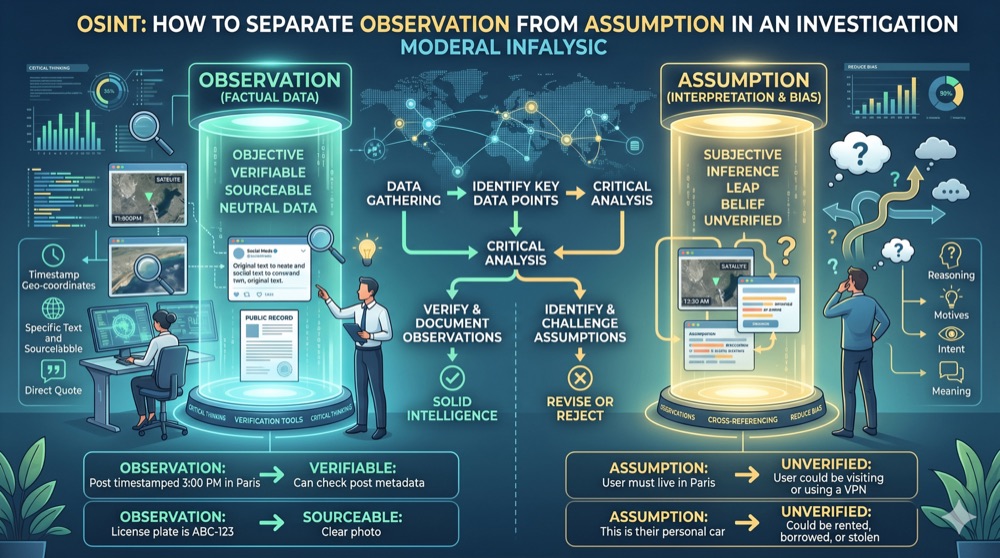
How to Separate Observation from Assumption in an OSINT Investigation
Learn to distinguish what a source shows from what you infer, and document uncertainty throughout an OSINT investigation.
Read article →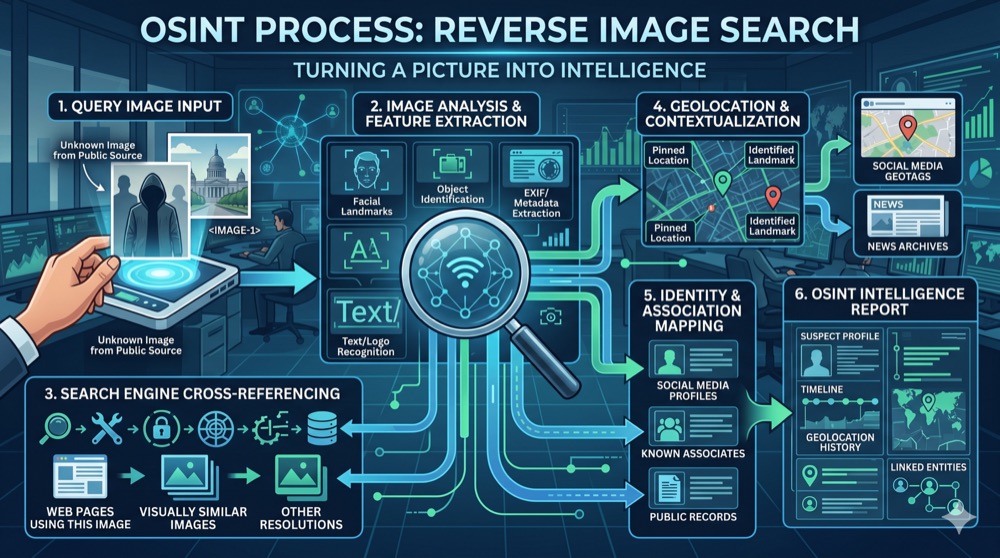
Reverse Image Search Is Not One Search: A Better Four-Step Workflow
A four-step reverse image search workflow for checking image origins, context, and competing explanations.
Read article →
How to Build and Test Competing Hypotheses in OSINT
Build and test competing hypotheses in OSINT research to challenge assumptions and reduce confirmation bias.
Read article →