What Makes an OSINT Source Reliable?
BY OSINT BLOG
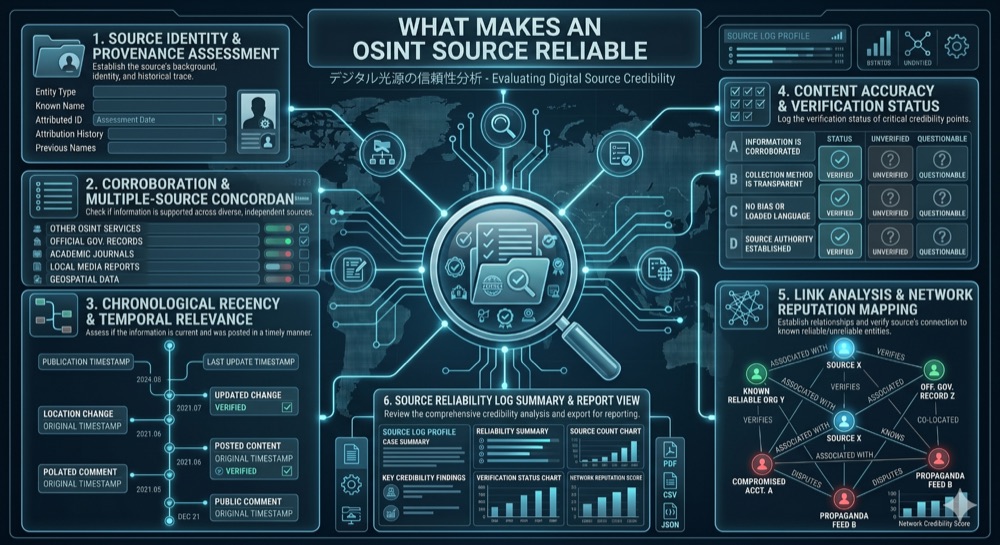
Introduction: Why Source Reliability Matters in OSINT
The foundation of credible intelligence analysis is reliable information. In open-source intelligence work, where information comes from publicly available sources of varying quality and trustworthiness, the ability to systematically evaluate source reliability is essential. A single unreliable source can compromise an entire analysis, leading to incorrect conclusions and flawed decision-making.
Defining Source Credibility and Reliability
While often used interchangeably, credibility and reliability have distinct meanings:
**Credibility** refers to the believability of a source—whether the source is trustworthy and has a track record of providing accurate information.
**Reliability** refers to the consistency and dependability of a source—whether the source consistently provides accurate information over time.
A source can be credible but unreliable (occasionally provides accurate information but is inconsistent), or reliable but not credible (consistently provides information, but the information is often inaccurate).
Evaluating Source Authority and Expertise
Assess whether the source has genuine expertise in the subject matter:
- **Professional credentials**: Does the source have relevant education, training, or professional experience?
- **Track record**: Has the source previously provided accurate information on similar topics?
- **Institutional affiliation**: Is the source affiliated with a reputable organization?
- **Peer recognition**: Is the source recognized as an expert by peers in the field?
- **Transparency**: Does the source clearly explain their methodology and sources?
Be cautious of sources that claim expertise without demonstrable credentials or those who present themselves as experts in multiple unrelated fields.
Assessing Source Bias and Motivation
Understand what might motivate a source to provide information:
- **Financial incentives**: Does the source profit from the information they provide?
- **Political or ideological bias**: Does the source have a clear political or ideological agenda?
- **Institutional interests**: Does the source's organization have interests that might bias their reporting?
- **Personal relationships**: Does the source have personal connections that might influence their perspective?
- **Reputation concerns**: Is the source motivated to maintain a reputation for accuracy?
Sources with clear biases are not necessarily unreliable—but understanding their bias helps you interpret their information appropriately.
Corroboration Requirements and Cross-Referencing
No single source should be the sole basis for important conclusions. Implement corroboration requirements:
- **Multiple independent sources**: Seek confirmation from sources that independently arrived at the same conclusion
- **Diverse source types**: Corroborate with sources of different types (academic, journalistic, official, etc.)
- **Primary vs. secondary sources**: Prefer corroboration from primary sources when possible
- **Temporal consistency**: Does the information remain consistent over time?
- **Specificity matching**: Do corroborating sources provide the same specific details?
Be aware of "echo chamber" effects where multiple sources cite the same original source, creating an illusion of corroboration.
Red Flags and Warning Signs
Certain characteristics suggest a source may be unreliable:
- **Extraordinary claims without evidence**: Claims that contradict established facts without strong supporting evidence
- **Vague or unverifiable claims**: Information that cannot be independently verified
- **Inconsistency**: The source contradicts itself or previously published information
- **Sensationalism**: Information designed to provoke emotional reactions rather than inform
- **Lack of transparency**: Unwillingness to explain sources or methodology
- **Ad hominem attacks**: Attacking critics rather than addressing substantive criticism
- **Appeal to authority**: Citing authority figures without substantive evidence
- **Conspiracy thinking**: Suggesting that contradictory evidence is part of a conspiracy
Building a Source Evaluation Framework
Develop a systematic approach to source evaluation:
1. **Identify the source**: Who is providing this information? What are their credentials? 2. **Assess authority**: Does this source have genuine expertise in this area? 3. **Evaluate bias**: What might motivate this source? What are their potential biases? 4. **Check track record**: Has this source provided reliable information previously? 5. **Seek corroboration**: Can you find independent confirmation of this information? 6. **Assess specificity**: How specific and verifiable are the claims? 7. **Document reasoning**: Record your assessment and the evidence supporting it
Practical Examples of Reliable vs Unreliable Sources
**Reliable sources typically:** - Have clear institutional affiliation and transparency - Provide specific, verifiable information - Acknowledge limitations and uncertainties - Correct errors when discovered - Have a track record of accuracy - Disclose potential biases
**Unreliable sources typically:** - Make vague, unverifiable claims - Lack transparency about sources or methodology - Refuse to acknowledge errors - Make extraordinary claims without evidence - Have a history of inaccuracy - Conceal potential biases
Conclusion
Source reliability is not binary—sources exist on a spectrum from highly reliable to completely unreliable. By systematically evaluating source authority, bias, track record, and corroboration, OSINT professionals can make informed judgments about source reliability and produce more defensible intelligence products. Remember: the most important sources are those that have demonstrated reliability through consistent accuracy and transparency.