When to Stop Searching: Defining Completion in an OSINT Investigation
BY OSINT BLOG
Introduction: The Challenge of Knowing When to Stop
One of the most challenging aspects of OSINT work is knowing when to stop searching. Unlike traditional research with clear endpoints, OSINT investigations can theoretically continue indefinitely—there's always another source to check, another angle to explore, another connection to investigate. Without clear completion criteria, investigations can become inefficient, consuming resources without proportional increases in intelligence value.
Defining Investigation Completion and Scope
Investigation completion means you have gathered sufficient evidence to answer your research questions and meet your investigation objectives with appropriate confidence. This requires:
**Clear objectives**: What specific questions are you trying to answer?
**Defined scope**: What is in scope and what is out of scope?
**Success criteria**: What would constitute a successful investigation?
**Resource constraints**: What time and resources are available?
Without these definitions, you cannot determine when completion has been reached.
Diminishing Returns and Resource Constraints
Investigations follow a pattern of diminishing returns:
- **Early phase**: Initial research yields significant new information
- **Middle phase**: Continued research yields moderate new information
- **Late phase**: Additional research yields minimal new information
- **Exhaustion phase**: Further research yields no new information
At some point, the cost of additional research exceeds the value of potential new information. Recognizing this point is critical for efficient investigations.
**Resource constraints** include: - Time available - Personnel available - Budget - Tool access - Expertise required
These constraints should inform your completion criteria.
Quality vs Quantity in OSINT Research
More information is not always better. Consider:
**Depth vs breadth**: Should you deeply investigate a few leads or broadly investigate many?
**Corroboration requirements**: How many independent sources confirm a finding before you consider it established?
**Confidence levels**: What level of confidence is required for different types of conclusions?
**Actionability**: Does additional information change what you would recommend or conclude?
Focus on information quality and relevance rather than quantity.
Setting Investigation Objectives and Success Criteria
Clear objectives enable clear completion criteria:
**Objective**: Determine if a social media account is legitimate **Success criteria**: - Verified account ownership - Corroborated professional credentials - Consistent posting patterns with claimed location/timezone - No contradictory evidence
**Objective**: Identify all known associates of a target **Success criteria**: - Systematic search of all major social media platforms - Cross-referenced with public records - No new associates identified in final search phase - Documented methodology for reproducibility
Recognizing When You Have Sufficient Evidence
You have sufficient evidence when:
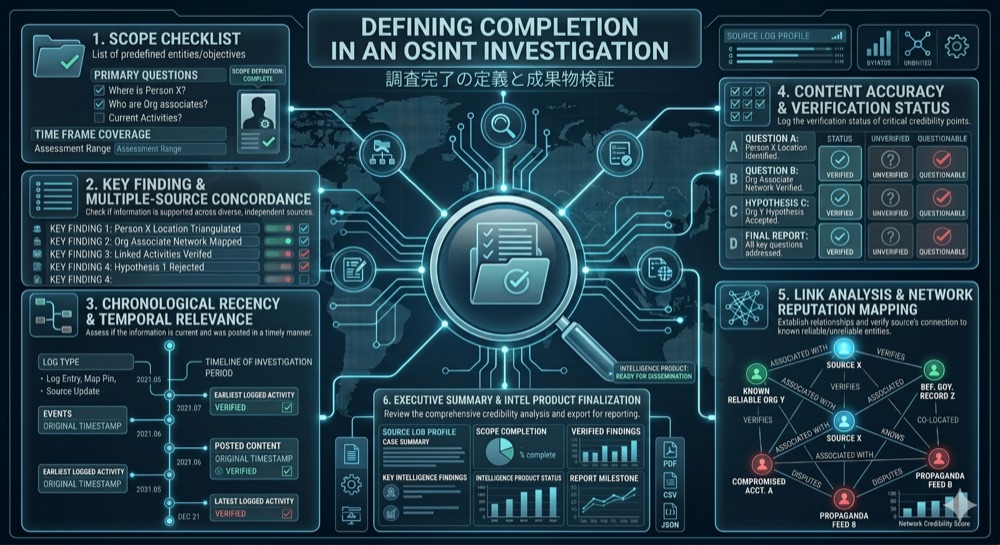
1. **Your research questions are answered**: Can you answer each investigation objective? 2. **Hypotheses are tested**: Have you evaluated competing hypotheses against available evidence? 3. **Evidence is corroborated**: Have key findings been confirmed by multiple independent sources? 4. **Gaps are identified**: Have you identified what information is missing and why? 5. **Diminishing returns are evident**: Are additional searches yielding minimal new information? 6. **Confidence is appropriate**: Do you have sufficient confidence in your conclusions given the stakes?
Documentation and Final Reporting
Before concluding an investigation, ensure:
**Complete documentation**: All evidence is logged and organized
**Methodology documented**: Your search strategy and sources are clearly recorded
**Limitations acknowledged**: What information was unavailable? What assumptions did you make?
**Confidence levels stated**: How confident are you in each conclusion?
**Recommendations clear**: What actions or further investigation do you recommend?
**Reproducibility enabled**: Could someone else follow your methodology and reach similar conclusions?
Common Mistakes in Investigation Closure
1. **Premature closure**: Concluding before sufficient evidence is gathered 2. **Indefinite continuation**: Never establishing clear completion criteria 3. **Confirmation bias**: Stopping when you've confirmed your hypothesis without testing alternatives 4. **Scope creep**: Expanding investigation scope without adjusting resources or timeline 5. **Inadequate documentation**: Failing to document methodology and evidence 6. **Ignoring limitations**: Not acknowledging what you don't know 7. **Overconfidence**: Expressing more confidence than evidence supports
Practical Decision Framework
Use this framework to determine if investigation is complete:
**1. Objectives met?** - Yes → Continue to step 2 - No → Continue investigating
**2. Evidence corroborated?** - Yes → Continue to step 3 - No → Seek additional sources
**3. Competing hypotheses tested?** - Yes → Continue to step 4 - No → Test alternative hypotheses
**4. Diminishing returns evident?** - Yes → Continue to step 5 - No → Continue investigating
**5. Resources exhausted or constraints reached?** - Yes → Proceed to closure - No → Consider additional investigation
**6. Confidence appropriate for stakes?** - Yes → Proceed to closure - No → Continue investigating or acknowledge limitations
Conclusion
Knowing when to stop searching is as important as knowing how to search effectively. By setting clear objectives, defining success criteria, recognizing diminishing returns, and maintaining appropriate confidence levels, OSINT professionals can conduct efficient, defensible investigations that deliver intelligence value without wasting resources. Remember: the goal is not to find everything possible, but to find what is necessary to answer your research questions with appropriate confidence.